Tubular specialties

Non-destructive electromagnetic and ultrasonic testing to characterize wall thinning, cracks, and corrosion under insulation without compromising the structural integrity of pipes and vessels.
High-Speed Electromagnetic Techniques (ECT / RFT)

Quantitative detection of wear, pitting, and erosion in ferrous and non-ferrous alloys using high-speed pipe inspection to optimize plant downtime.

High-Resolution Ultrasonic Profilometry (IRIS)

Absolute wall thickness measurement and $360^\circ$ topographic mapping using immersive ultrasound for accurate validation of remaining service life.

Complex Crack Detection Using Arrays (ECA)

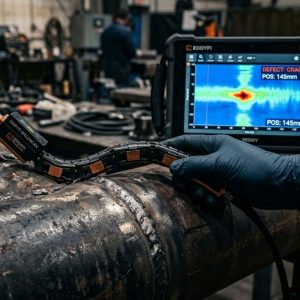
Eddy Current Array (ECA) inspection for multichannel mapping of surface and subsurface cracks in welded joints and tubular plates.

Non-Dismantling Evaluation of Corrosion Under Insulation (PEC)

A pulsed eddy current technique for evaluating wall loss in thermally coated pipes and heat exchangers, eliminating the cost of removing the insulation.

Inspection Services for Tubular Specialties

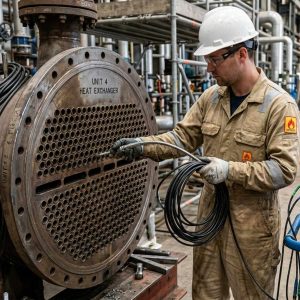
TECNA ICE’s specialized tubular services provide physical-chemical and quantitative characterization of degradation in tubular bundles, tanks, and pipes.

Certified Experience

More than 25 years of technical experience in Oil & Gas and energy across 6 Latin American countries.

Certificaciones empresa TECNA ICE
Experiencia en Evaluación y Mitigación de interferencias eléctricas en ductos | Tecnaice.
Years of experience in this service
+ 1
Projects executed
+ 1
Km of CIPS inspections
+ 1
Incident-free assessments
+ 1 mill h/m

At TECNA ICE, we combine more than 20 years of experience in the industrial sector with advanced electromagnetic and ultrasonic equipment.

Frequently Asked Questions

The choice depends on the material’s magnetic properties. The Eddy Current Testing (ECT) method requires nonmagnetic materials such as austenitic stainless steel, titanium, brass, or copper. If the tubes are made of carbon steel or ferromagnetic alloys, the ECT’s magnetic field is attenuated at the surface; in these cases, Remote Field Testing (RFT) is used, in which the electromagnetic field passes through the tube wall and re-enters, allowing both the inner and outer diameters to be evaluated.

Unlike ECT or RFT, which estimate wall loss based on variations in the phase and amplitude of an electromagnetic signal, IRIS (Internal Rotating Inspection System) uses an ultrasonic pulse transmitted through a rotating mirror in a water medium. This provides a direct and absolute measurement of wall thickness and is unaffected by variations in the material’s magnetic permeability or conductivity.

Yes. Pulsed Eddy Current (PEC) technology is designed to compensate for the presence of non-ferromagnetic protective coatings such as aluminum, stainless steel, or Galvalume. The device’s algorithm filters out the response from the outer coating and analyzes only the decay curve of the underlying base steel.

Unlike magnetic particle or penetrant testing, ECA does not require the removal of paint or non-conductive coatings, nor does it require aggressive cleaning through shot blasting. The technique can inspect through layers of paint up to 2 mm thick without losing sensitivity for crack detection.

For routine inspections, an initial statistical sample of between 10% and 20% of the tubes, strategically selected, is typically defined. However, if active damage mechanisms or recurring failures are detected, the testing scope is expanded to 100% of the bundle to ensure reliability before the equipment is started up.

Before and during the inspection, the system is calibrated using a reference tube made of the same material and having the same diameter and nominal thickness as the equipment being inspected. This reference tube contains standardized artificial defects (longitudinal and flat notches, and flat-bottomed holes at various percentages of wall thickness) as required by ASME Section V, Article 8.

IRIS requires that the pipes be completely free of scale or hard deposits, since the ultrasonic coupling uses water as a transmission medium and deposits attenuate the signal. In addition, the inspection speed of IRIS is slower than that of ECT or RFT, so it is typically used as a backup technique or for spot checks.

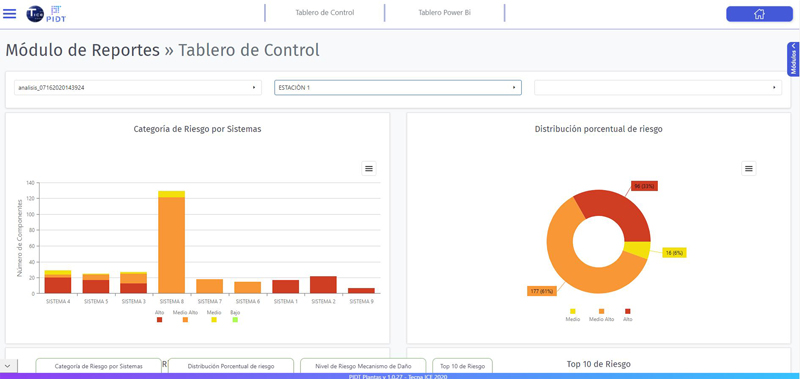
The deliverable includes a complete map of the tubular string, color-coded according to the percentage of wall loss per tube; a list of tubes recommended for plugging or replacement; C-scan/B-scan images of representative defects; and a remaining life calculation report in accordance with API 510.

// Schedule an inspection of insulated pipes for your next plant shutdown

Get personalized guidance.

Quantitative inspection technology, certified personnel, and advanced analytics for decision-making.

Multi-Technology Electromagnetic Coverage

We have integrated platforms capable of performing ECT, RFT, NFT, MFL, and IRIS tests on a single unit, allowing us to adapt immediately to any metallurgical conditions in the field.

ASNT / ISO 9712 Certified Personnel

Level II and III inspectors dedicated exclusively to interpreting complex electromagnetic and ultrasonic signals in heat transfer components.

Reports Aligned with ASME and API Codes

Audit-ready quantitative reports, structured to directly feed into fitness-for-service analyses (API 579) and working pressure calculations.

Reducing Plant Downtime

High-speed probes and multichannel data acquisition systems that maximize the number of pipes inspected per shift, optimizing the critical path of maintenance.


    This form uses Akismet to reduce spam. Learn how your data is processed.

    1