
Description
Technical Support for Critical Assets: At TECNA ICE, we apply the API 579 standard to provide quantitative assessments of the structural integrity of equipment that exhibits defects or degradation during service.
Service Description
The Fitness-for-Service (FFS) Assessment is a multidisciplinary engineering practice that determines whether a piece of equipment (pressure vessel, tank, piping) is safe to continue operating after a damage condition—such as loss of wall thickness, cracks, hydrogen blistering, or deformations—has been identified. At TECNA ICE, we go beyond simple inspection; we use mechanical models and international acceptance criteria to technically justify the asset’s continued operation, optimizing repair costs and extending its service life.
FFS Assessment Levels
Level 1
Basic Complexity: A quick assessment conducted by on-site inspectors using tables and conservative criteria. Ideal for immediate on-site decisions regarding common defects.
Level 2
Intermediate Complexity: Performed by specialized engineers. Requires detailed calculations and a more in-depth analysis of inspection data to reduce the conservatism of Level 1.
Level 3
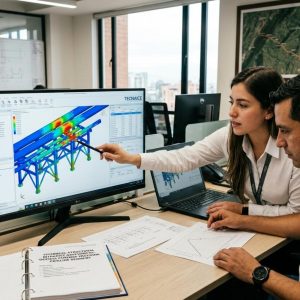
Advanced Complexity: Involves numerical analysis using the finite element method (FEA). It is applied to complex geometries, severe loading conditions, or when the previous levels fail.
Damage Mechanisms Evaluated
TECNA ICE evaluates a wide range of critical conditions, including:
- Loss of thickness (corrosion).
- Pitting.
- Cracks and fractures.
- Fire damage.
- Bulges and distortions.
- Damage caused by H2S (HIC/SOHIC).
- Laminations and blisters.
- Weld misalignment.
Have you detected a defect in critical equipment and need to know if it can continue to operate?
Contact us for an advanced engineering-based Fitness for Service (FFS) assessment.